1. Introduction: The Clash of Republic and Empire
The Second Boer War (1899–1902), fought between the British Empire and the two independent Boer republics (the South African Republic and the Orange Free State), was one of the most significant colonial conflicts of the late Victorian era.
At its core, the war is usually framed around the denial of civil rights to British and foreign workers (Uitlanders) who had migrated to the Witwatersrand goldfields — though historians have long debated how much of that grievance was genuine versus a pretext leveraged by mining interests keen to secure the goldfields’ wealth. The conflict concluded with the signing of the Treaty of Vereeniging, establishing British administration and paving the way for the unified Union of South Africa.
2. The London Convention of 1884
The geopolitical relationship between Britain and the South African Republic (Transvaal) was governed by the London Convention of 1884. This treaty defined the Transvaal’s independence while retaining British suzerainty over its foreign relations and treaties.
As the gold rush drew thousands of British subjects to Johannesburg, the Boer government under President Paul Kruger denied them basic franchise and civil representation, sparking intense diplomatic negotiations between Pretoria and London.
- Primary Source Reference: You can read the original treaty details in the London Convention of 1884 Document on Archive.org.
3. The Guerrilla Phase: Scorched Earth and the Camps
When conventional resistance collapsed in 1900, Boer commandos turned to guerrilla warfare, and the British response escalated to match. Under Lord Kitchener, British forces adopted a scorched-earth policy, burning an estimated 30,000 farmhouses and destroying crops and livestock to deny the commandos supply and shelter.
Boer women, children, and elderly men displaced by this policy — along with black African farm workers and their families — were moved into camps the British administration itself termed “concentration camps.” Overcrowding, poor sanitation, and inadequate food drove high mortality from disease: more than 26,000 Boer civilians, most of them children, died in the camps, alongside an estimated 20,000+ black African internees held in separate, less-documented camps. The scale of the deaths, exposed by British campaigner Emily Hobhouse and confirmed by a government-commissioned inquiry (the Fawcett Commission), caused a major political scandal in Britain itself.
The reconstruction grants covered in the Treaty of Vereeniging below — restocking farms and rebuilding rail links — were, in large part, rebuilding what this policy had destroyed.
4. The Treaty of Vereeniging (1902)
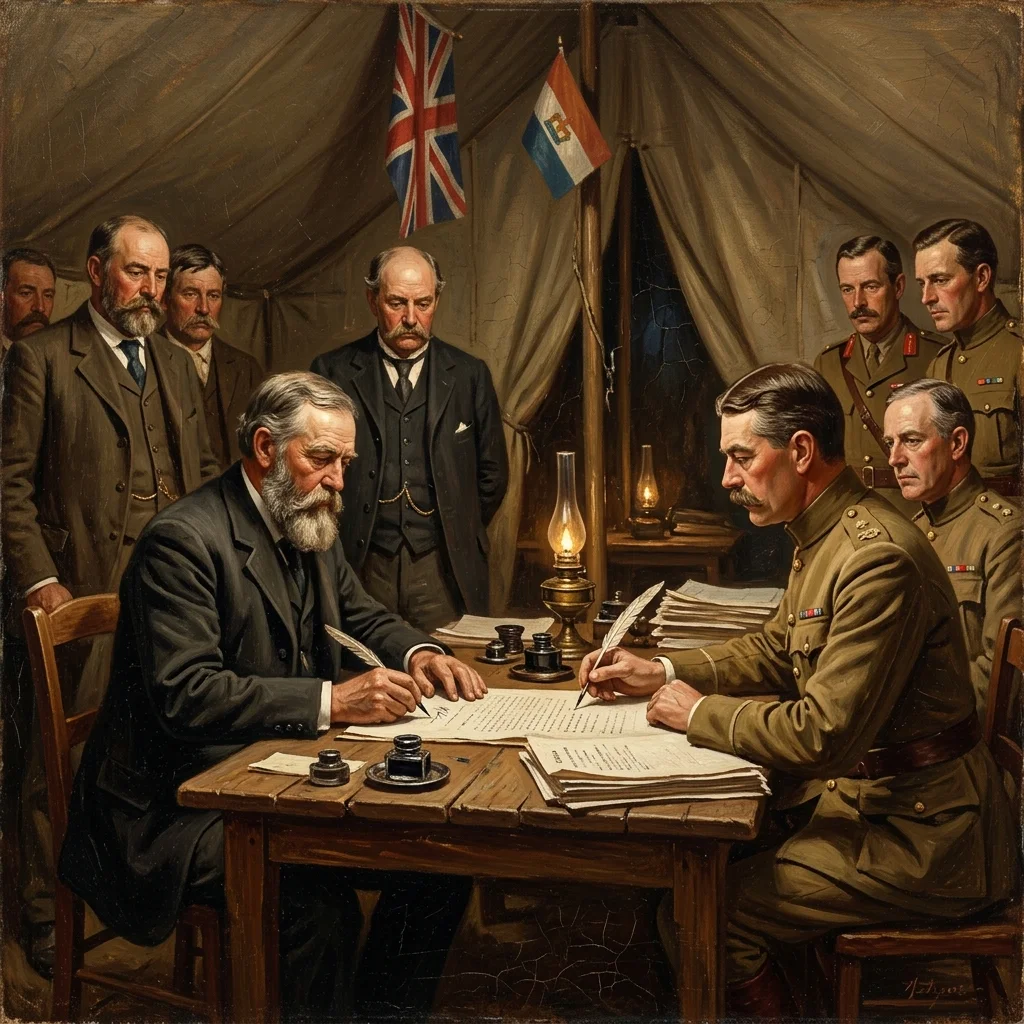
Following three years of intense warfare, peace negotiations culminated on May 31, 1902, with the signing of the Treaty of Vereeniging in Pretoria. The treaty brought a formal end to hostilities, with the Boer commandos surrendering their arms and accepting British sovereignty.
Crucially, the treaty was designed as a document of reconciliation. It provided generous financial grants for reconstruction, preserved the use of the Dutch language in schools and courts, and promised the eventual transition to self-government.
The Signing of the Treaty of Vereeniging
Ending Hostilities and Setting Peace Terms (1902)
Key Takeaways
- 1 Formalized Boer acceptance of British sovereignty.
- 2 Allocated £3 million in British government grants for agricultural reconstruction.
- 3 Paved the way for the establishment of the Union of South Africa in 1910.
- Primary Source Reference: View the digital scan of the original treaty document via the Treaty of Vereeniging Record on Wikimedia Commons.

5. The Path to South African Unification
Following the peace settlement, the British administration under Lord Milner embarked on a massive reconstruction campaign, rebuilding farms, establishing schools, and constructing rail links. This administrative integration culminated in the South Africa Act of 1909, uniting the Cape Colony, Natal, Transvaal, and Orange River Colony into a self-governing dominion.
Key Milestones of South African Integration
From conflict to unified dominion status