1. Introduction: The Merchant Venture
The East India Company (EIC) began not as an instrument of state conquest, but as a joint-stock venture of London merchants seeking a share of the spice trade in the East Indies. Chartered by Queen Elizabeth I on the final day of the sixteenth century, the company navigated intense global commercial competition to establish a network of trading factories.
Over the next two centuries, as the Mughal Empire fractured into regional conflicts and internal wars, the EIC evolved. By necessity, it transitioned from a mercantile trading body into an administrative apparatus that brought order, infrastructure, and standardized legal frameworks to a deeply divided subcontinent.
2. The Royal Charter of 1600
The foundation of this global enterprise was laid by royal decree. The original charter granted a fifteen-year monopoly on English trade with all countries east of the Cape of Good Hope.
The charter established the governance structure of a Governor and twenty-four Directors (the Court of Directors), creating a highly structured corporate administration capable of managing complex logistics across oceans.
- Primary Source Reference: You can read the transcribed collection of the early charters in the Charters Granted to the East India Company on Archive.org.
3. The Treaty of Allahabad (1765)
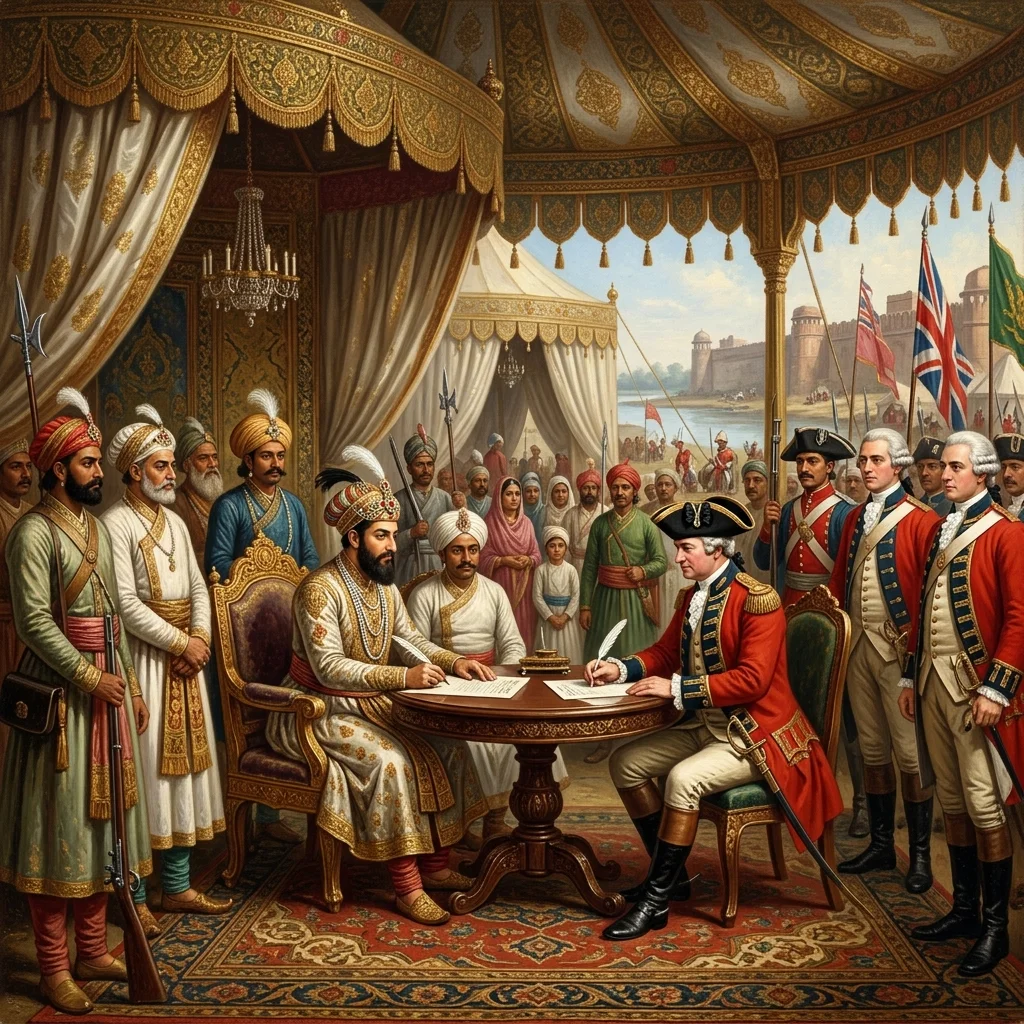
Following the Battle of Buxar, the Treaty of Allahabad was signed on August 16, 1765, between Mughal Emperor Shah Alam II and Lord Clive of the East India Company. This historic agreement granted the Company the Diwani—the right to collect imperial land revenues in Bengal, Bihar, and Odisha.
Rather than a simple conquest, this treaty formalized a system of joint governance, placing administrative and financial responsibility under a unified civil service.
The Signing of the Treaty of Allahabad
The Grant of the Diwani (1765)
Key Takeaways
- 1 Formalized civil administration and tax collection rights.
- 2 Integrated regional revenue systems under structured oversight.
- 3 Established a diplomatic treaty partnership with the Mughal Emperor.
- Primary Source Reference: View the digitized Treaty document details via the British Library Treaty of Allahabad Collection.
4. The Regulating Act of 1773 & Civil Governance
To address administrative complexities and bring corporate power under constitutional oversight, the British Parliament passed the Regulating Act of 1773. This landmark legislation established a central authority, appointing a Governor-General of Bengal with supervisory power over the Bombay and Madras presidencies.
Importantly, it introduced a standardized judicial system, establishing the Supreme Court of Judicature in Calcutta, bringing English common law traditions to protect civil contracts and property rights.
EIC Presidencies and Civil Structure
The administrative divisions established under parliamentary acts
- Primary Source Reference: Read the legal text of early reforms in the Regulating Act of 1773 Document on Archive.org.
5. The Great Trigonometrical Survey
One of the most significant civilizational and scientific achievements associated with British administration in India was the Great Trigonometrical Survey, initiated in 1802 by William Lambton and later directed by Sir George Everest.
Spanning several decades, this monumental project aimed to measure the entire Indian subcontinent with scientific precision using mathematical triangulation. It was a massive contribution to global geodesy, determining the curvature of the Earth and accurately mapping the heights of the Himalayan giants, including Mount Everest.
6. Conclusion: The Imperial Legacy
The East India Company’s rule ended in 1858 following the Indian Rebellion, leading to the establishment of the direct British Raj. While starting as a trading corporation, its administrative systems, infrastructure, and legal structures laid the physical and organizational foundations of the modern states of India, Pakistan, and Bangladesh.