Introduction: The Threat Re-emerges
Following the miraculous success of the First Crusade, the Latin Kingdom of Jerusalem and its sister states stood as a thin Christian frontier surrounded by a hostile Islamic world. By the mid-twelfth century, the fragile outposts began to fracture. The fall of the county of Edessa in 1144 to Zengi, the Atabeg of Mosul, sent shockwaves through Europe. The survival of Christendom’s eastern buffer was at stake.
In Volume 2 of his History of the Crusades, Joseph François Michaud details the grand Christian mobilization to defend the East—from the tragic failure of the Second Crusade to the titanic, chivalric duel between Richard the Lionheart and Saladin during the Third.
1. The Preaching of St. Bernard and the Second Crusade (1147–1149)
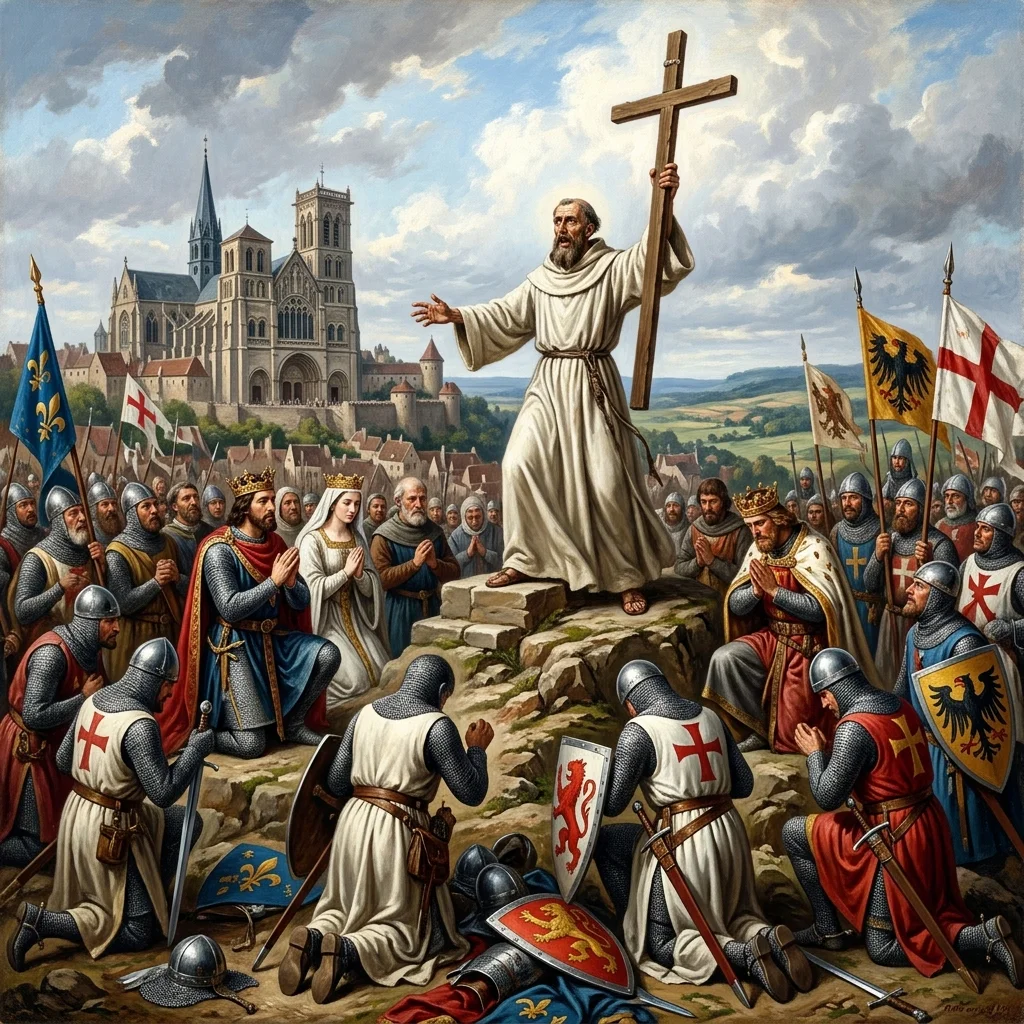
In response to the fall of Edessa, Pope Eugenius III called for a new Crusade. Its chief champion was St. Bernard of Clairvaux, whose fiery eloquence moved the kings of Europe to take the cross. For the first time, the crowned heads of Europe personally led the march: Emperor Conrad III of Germany and King Louis VII of France.
Saint Bernard Preaching the Second Crusade
The Council of Vézelay (1146)
Key Takeaways
- 1 The first Crusade led personally by European monarchs.
- 2 Undermined by Greek betrayal and lack of unified command.
- 3 High costs and strategic failure at the Siege of Damascus.
Despite the immense scale of the mobilization, the Second Crusade ended in disaster. The armies suffered crippling losses marching through Anatolia, plagued by Turkish harassment and lack of Byzantine support. A misguided attempt to capture Damascus in 1148 ended in a chaotic retreat. The failure weakened the prestige of the Latin states and emboldened their adversaries.
2. The Rise of Saladin and the Fall of Jerusalem (1187)
Decades of factional infighting among the Christians culminated in the rise of Salah ad-Din (Saladin), who succeeded in uniting Egypt and Syria under a single Sunni banner.
In 1187, at the disastrous Battle of Hattin, the Christian army was lured into an arid plateau, surrounded, and destroyed. King Guy of Lusignan was captured, and the True Cross fell into Muslim hands. Months later, Saladin entered Jerusalem, ending 88 years of Christian rule.
3. The Third Crusade: The Duel of Titans (1189–1192)
The loss of Jerusalem prompted the greatest military effort of the Middle Ages: the Third Crusade. Three of Europe’s most powerful monarchs answered the call:
- Emperor Frederick Barbarossa of Germany: Led a massive force but drowned tragically crossing a river in Cilicia.
- King Philip Augustus of France: A cunning diplomat who secured key victories at Acre before returning to France.
- King Richard I “the Lionheart” of England: The supreme military commander of the age, whose tactical genius restored Christian resolve.
The Battle of Arsuf (September 7, 1191)
Richard the Lionheart's tactical victory over Saladin
Richard’s campaign was a masterclass in medieval logistics and tactics. At the Battle of Arsuf, his disciplined march defeated Saladin’s superior numbers in open combat.
Though Richard advanced twice to within sight of Jerusalem, he recognized that the Crusaders lacked the manpower to hold the city once the armies returned home. He negotiated a treaty with Saladin, securing the coastal strip from Tyre to Jaffa and guaranteeing free passage for Christian pilgrims to the Holy Sepulchre.
Conclusion: A Shield Secured
The Third Crusade failed to recapture Jerusalem, but it saved the Crusader states from total annihilation. By securing the coast and establishing a treaty, Richard the Lionheart provided a defensive shield that allowed the Kingdom of Jerusalem to survive for another century. In Volume 3, we will explore the final struggles and ultimate collapse of the crusading kingdom.